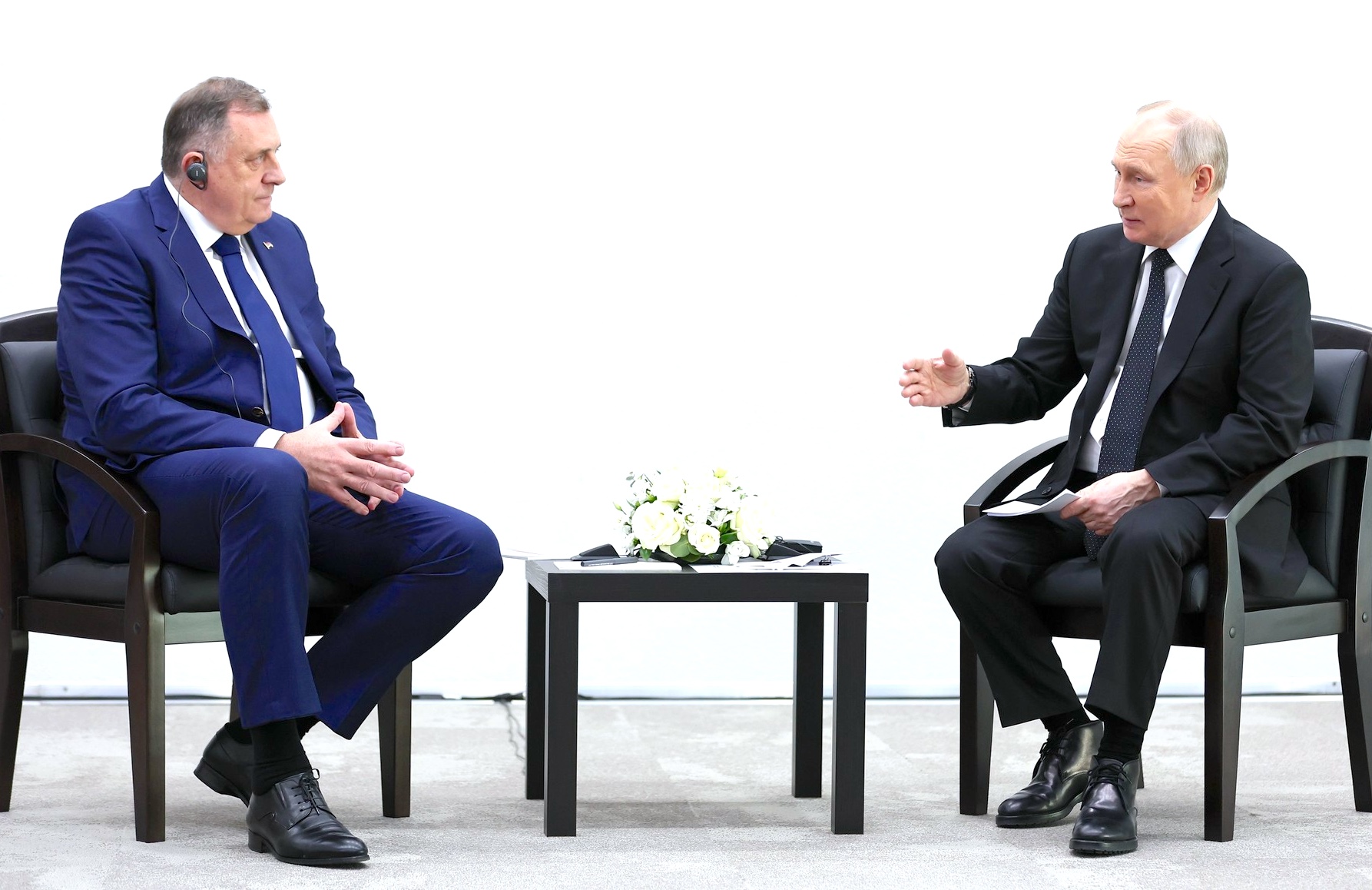
The Trump administration has lifted U.S. sanctions on Milorad Dodik, the powerful Serbian nationalist who led Republika Srpska in Bosnia and Herzegovina until earlier this month, following an intensive lobbying effort by figures close to former President Donald Trump, The New York Times reported.
The removal of penalties also extends to members of Dodik’s family, inner circle and affiliated companies that Treasury Department officials had previously described as part of a “corrupt patronage network,” the newspaper reported.
Treasury’s announcement offered no public rationale for the about-face, and a spokesperson declined to comment, the Times said.
Dodik, a close ally of Russian President Vladimir V. Putin, had been sanctioned for actions the United States said undermined the U.S.-brokered peace accord that ended the Balkans’ wars in the 1990s.
Sanctions relief could allow Dodik to retain significant influence in the Serb-controlled, self-governed territory of Republika Srpska even without a formal government post, the Times reported.
The decision followed weeks of engagement between senior U.S. diplomats and Dodik’s allies, alongside public praise from Washington for steps in Banja Luka such as naming an interim president and easing off measures viewed as flouting the peace deal. According to Justice Department filings cited by the Times, the Srpska government retained well-connected lobbyists and lawyers, at a cost of roughly $300,000 a month or more, to make the case in Washington.
Among them was attorney Marc Zell, whose contract called for $1 million over a year plus a “success fee” tied to the termination of all sanctions, the Times reported. Others advocating for Dodik included Rudolph W. Giuliani, Michael T. Flynn, conservative activist Laura Loomer, and former Illinois governor Rod Blagojevich, who was pardoned by Trump and subsequently signed his own contract with the Srpska government.
Caroline Wren, a lobbyist close to Trump’s circle whose firm Tactic Global signed a $100,000-a-month agreement with Republika Srpska, said the move signaled that the United States would not allow “unelected bureaucrats” to target “Christian leaders,” according to the Times.
Adnan Cerimagic of the European Stability Initiative told the Times that without a clear U.S. explanation, the move risks signaling that “lobbying, money and individuals close to the administration” can secure sanctions relief with minimal concessions.
Read more at The New York Times